

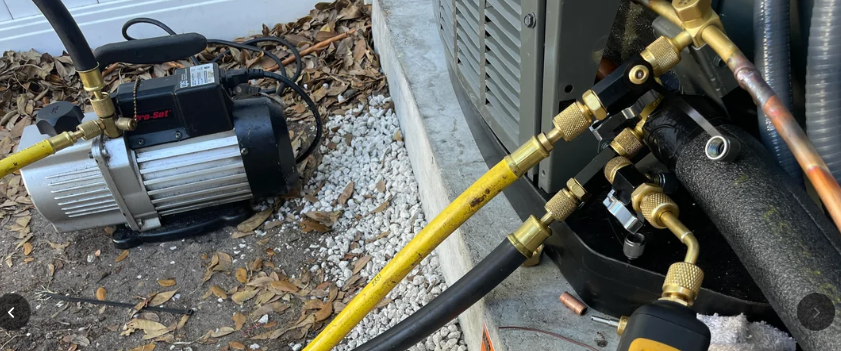
Evacuation removes contaminants like moisture and non-condensable gases from an HVACR system, especially one going into service for the first time or going back into service after a repair. Pulling a deep vacuum has always been a best practice, and with the new A2L refrigerants it’s now part of the equipment manufacturers’ installation requirements.
Before a system is ready to be charged, we pull a deep vacuum and then do a decay test. How fast the vacuum rises tells us whether the system is dry and tight enough to run. Everything leaks a little, but the decay test sets a limit we don’t want to go past. If the vacuum rises past that limit, we have a problem to track down.
When a system fails the decay test, one of two things is usually happening.
Cause #1: The System Still Has Moisture in It
Moisture can hide in a system, sometimes trapped under the compressor oil. If the decay test points to moisture, a multiple evacuation with a nitrogen sweep will greatly reduce the amount of moisture left in the system.
Nitrogen Sweep, Step by Step
- Pull the system down to between 1,000 and 2,500 microns.
- Isolate the vacuum pump with the core tools and disconnect the vacuum hose from the low side of the system.
- Break the vacuum with dry nitrogen, introduced at the side port of the core tool, until the system is back to atmospheric pressure (760,000 microns).
- Sweep nitrogen through the system at 1–3 PSIG from the high side to the low side, letting it vent out the open port of the core tool on the low side.
- Stop the nitrogen, reconnect the vacuum pump and evacuate again. Repeat the sweep if the decay test still shows moisture.
Don’t pressurize the system during the sweep. You want nitrogen flowing through it, not building up in it. Typically, no more than a triple evacuation with a nitrogen sweep will be needed.
Cause #2: The System Has a Small Leak
Sometimes a small leak gets past the initial pressure test. Some leaks show up more under vacuum than under pressure.
A micron gauge is very good at showing you a leak, but leak testing under vacuum is not an acceptable substitute for a standing nitrogen pressure test. During evacuation, a leak pulls moisture and air into the system. If you find a leak under vacuum, break the vacuum with dry nitrogen and find the leak under pressure.
Do not open the system to atmosphere while it’s under a vacuum. Doing so undoes all your time and effort to that point.
How to Tell the Two Apart
Watch what the micron gauge does after you isolate the pump:
- A leak: the reading keeps rising and doesn’t stop until the system reaches atmospheric pressure.
- Moisture in a tight system: the rise levels off once the water boils off and the pressure inside matches the vapor pressure of water. Between 72°F and 80°F, that’s roughly 20,000 to 26,000 microns. At that point the reading holds steady.
Note: A system that keeps leveling off around 3,500–4,500 microns may have frozen its moisture into ice. If that happens, you may need to warm the system with an outside heat source to get the moisture out.
Final Thoughts
The two main causes of a failed decay test are moisture and leaks, and each has a different fix. They also look different if you track your vacuum with an app: a wet system levels off above the decay limit, while a leaky system keeps climbing in a fairly straight line well past it.
A leak that slipped past the nitrogen pressure test needs to be fixed like any other leak. We don’t use a deep vacuum for leak testing, because the pump pulls moisture in through the leak. But a deep vacuum can tell you the system leaks, and that leak needs the same attention as one you found with bubbles or a nitrogen pressure test.
Related reading: Why Compressors Fail (And Why the New One Will Too, If You Miss the Cause)